Statement of the Problem
I claim:
Given two points in a plane  and
and  , the distance
between them may be calculated as
, the distance
between them may be calculated as  .
.
I further claim that we may determine this starting from the area of a rectangle:
 The
area of a rectangle with height
The
area of a rectangle with height  and
width
and
width  may be found with
  .
.
The Plan Of Attack
- Use the rectangle area formula to derive a formula for the area of a square.
- Be rigorous!
- Define a square: A square is a rectangle with all four sides equal.
- So a square is a rectangle.
- So if the square has sides of length
 ,
the area of that rectangle with sides
and is
,
the area of that rectangle with sides
and is  .
.
- ... and, from that, a rule from the area of a square to the length of
each side.
- If we have the area of a square, we can solve
 to
to  .
.
- If we have the area of a square, we can solve
- Use the rectangle area formula for the area of a right triangle.
- Draw a right triangle with height
and width .
- Duplicate it so that there is a rectangle with height
and width .
- Since there are two triangles, and they must sum to the area of the
full rectangle , the area
of each must be
 .
.
- Draw a right triangle with height
- Use the above derivations to prove the Pythagorean Theorem:
 Within
every right triangle whose legs are of length
Within
every right triangle whose legs are of length  and
and  and whose hypotenuse is of
length
and whose hypotenuse is of
length  , the lengths of the sides
will have the relationship
, the lengths of the sides
will have the relationship  .
.- Graded Classwork: Using the Internet or any other resource, find a proof of the Pythagorean Theorem which you can understand and explain. Write it in your own words and print it out or email it to me at [email protected]
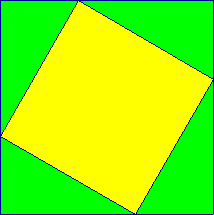 Sketch
a right triangle, label its sides ,
, and ,
and duplicate it four times, as in this illustration.
Sketch
a right triangle, label its sides ,
, and ,
and duplicate it four times, as in this illustration.- Calculate the area of each right triangle
 ,
then multiply by four to determine the area of all four right triangles
together
,
then multiply by four to determine the area of all four right triangles
together  .
. - Calculate the area of the large square
2.gif) .
. - Subtract the area of the four triangles, leaving only the area of
the inner square
 .
. - Since the inner square has sides of length ,
its area is also
 and, by
transitivity, .
and, by
transitivity, .
- Define the distance between two points
 and
and  on the same axis (number line)
as
on the same axis (number line)
as  . So our only real
problem is to prove the distance between two points which are diagonal from
each other.
. So our only real
problem is to prove the distance between two points which are diagonal from
each other.
- This is just a definition. Explain it. Notice the absolute-value bars; the distance between two points on a number line is always (positive and) the same whichever way you look at the points because distance does not have direction.
- (If they're curious, mention vectors, which have both distance and direction.)
-
 Construct
a right triangle using our diagonal points
and , and a third
point
Construct
a right triangle using our diagonal points
and , and a third
point  .
.
- Note that the orientation of this triangle may be different from in this diagram. Is that a problem? No.
- Use the smaller distance formula (step 5) to determine the lengths of
both legs of this right triangle.
- The horizontal leg will have length .
- The vertical leg will have length
 .
.
- The horizontal leg will have length
- Use the Pythagorean theorem to determine the length of the hypotenuse
of this right triangle... which is the distance between our original two
points.
- Since this is a right triangle, the hypotenuse will have length
 .
. - Since we're squaring those inner terms, the absolute-value bars don't
matter any more: .
- Since this is a right triangle, the hypotenuse will have length
- Demonstrate that the smaller distance formula works with this new distance
formula, so we need only use
regardless of where on the plane the points are.
Assessments
Proof-related questions:
 Given
a parallelogram with measurements as shown, can you prove that its area
is still ?
Given
a parallelogram with measurements as shown, can you prove that its area
is still ? Given
a triangle with measurements as shown, can you prove that its area is still
?
Given
a triangle with measurements as shown, can you prove that its area is still
? Given
a kite with diagonals
Given
a kite with diagonals  and
and  ,
can you prove that its area is
,
can you prove that its area is  ?
?